Why do people postpone things they intend to do even when they expect the delay to cost them? Researchers have offered explanations involving anxiety, perfectionism, self-handicapping, resistance, emotions, and distant rewards. A useful theory needs to explain both which tasks get postponed and why motivation so often increases as a deadline approaches.
Not every delay is procrastination. Deliberating, revising or strategically waiting can make sense. The central definition concerns voluntarily delaying an intended course of action despite expecting to be worse off for the delay. My 2007 meta-analysis reviewed the evidence across competing explanations. One especially useful integrative account is Temporal Motivation Theory (TMT), developed with Cornelius König.
Explore the Procrastination Equation
Motivation = (Expectancy × Value) ÷ (1 + Impulsiveness × Delay)
The formula describes how attractive an activity is, accounting for its expected reward and the time before that reward arrives. A task with a valuable but distant outcome often loses out to an alternative that feels rewarding now. As the deadline gets closer, the delayed task’s relative appeal can rise sharply.
Interactive graph: change the variables
Open the full-size interactive simulator — a larger, graph-focused view with no code panel. You can also use the embedded version below.
Move the controls to explore how expectancy, value, impulsiveness, delay and the attractiveness of an immediate alternative affect motivation. The graph illustrates when a delayed task becomes preferable as its deadline approaches.
Open the interactive graph without the code panels for a larger view. The WordPress embed may show source code beside the graph by default; select its Result tab to emphasize the visualization. View the source on CodePen. This teaching model is not a psychological test or a calibrated individual prediction.
Static reference graph
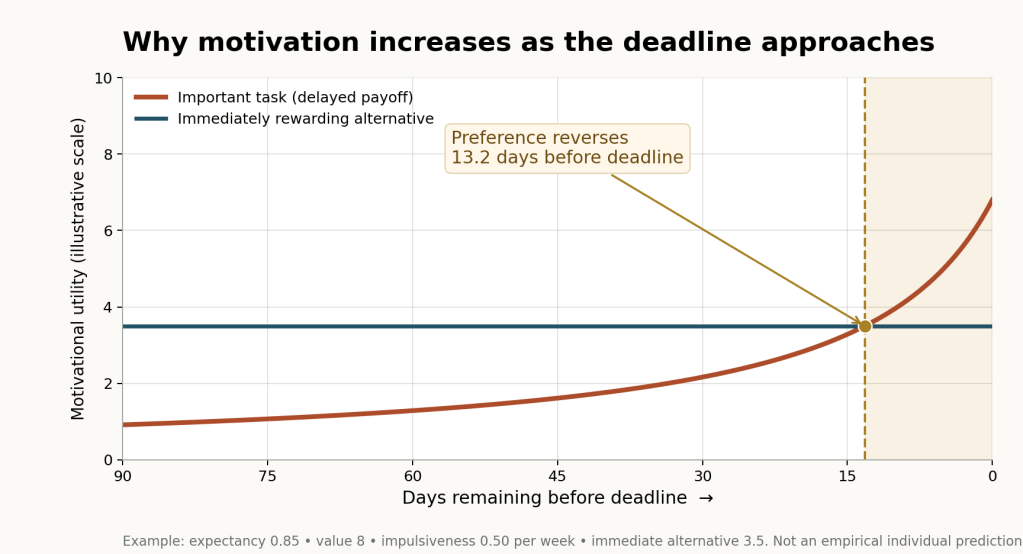
The static illustration above shows one possible preference reversal. For comparison, you can also explore Christian Burkhart’s independently developed TMT simulation. Neither demonstration is a validated personal assessment.
Four variables, one decision
- Expectancy: your perceived chance that acting will lead to a successful outcome. Greater confidence typically makes action more attractive.
- Value: how rewarding or meaningful the outcome or activity feels. An aversive task can have lower subjective value even if its eventual payoff is important.
- Impulsiveness: sensitivity to the delay before rewards. Higher sensitivity discounts distant goals more strongly. In an illustration, this is a numerical parameter—not a personal diagnosis.
- Delay: the time until a relevant reward or consequence. Greater delay usually lowers current utility; the units of delay must be scaled consistently with impulsiveness.
The 1 in the denominator prevents the utility expression from becoming undefined when delay is zero. We compare the utility of competing choices, not simply the motivational appeal of one task in isolation.
An essay due in three months
Imagine a student with 90 days to complete an important essay. Suppose expectancy is 0.85, value is 8, sensitivity to delay is 0.50 per week, and an instantly available temptation has utility 3.5. In this hypothetical example the essay’s attractiveness is below that of the alternative for most of the term. It crosses the alternative about 13 days before the deadline. More impulsiveness would move the predicted crossover closer to the deadline; greater expectancy or value would move it earlier.
That crossing is not the actual date a real student will begin. The example assumes an immediate alternative whose utility stays constant, a delayed reward associated with the deadline, and unchanged circumstances. Real tasks also involve preparation time, habits, changing emotions, opportunities and constraints.
How other theories contribute
Anxiety, fear of failure and perfectionism
Stress and fears about evaluation can make work unpleasant, but anxiety alone does not adequately explain why people delay and then work intensely at the last minute. Perfectionism also has multiple dimensions: high personal standards need not produce the same behaviour as self-critical concerns about mistakes. The task may feel less valuable, or success may seem less attainable. Both fit within the wider expectancy–value framework.
Self-handicapping
People sometimes erect obstacles to performance so that possible failure can be attributed to poor preparation rather than limited ability. Delaying can serve that purpose, but self-handicapping and procrastination are not equivalent. The wish to protect self-esteem may explain particular episodes without describing every person’s habitual delay.
Rebelliousness and autonomy
Resistance to an imposed demand can make a task aversive. However, rebelliousness and hostility are not strong general predictors of procrastination. Their effects are better considered in context, including whether the person experiences the task as controlling or pointless.
Short-term mood repair
An important complementary account treats avoidance as a way of repairing mood. Putting off a stressful or boring task provides immediate relief, while the resulting costs are transferred to the future self. Sirois and Pychyl developed this perspective in their 2013 review. It highlights emotional mechanisms involved in choosing the immediate alternative, which TMT can represent in the comparison of values over time.
What the research supports
The 2007 meta-analysis found particularly relevant correlates involving self-efficacy, task aversiveness, impulsiveness, distractibility and delay. Our 2018 longitudinal investigation found deadline-related patterns and intention–action gaps broadly consistent with TMT. A 2024 study of 2,351 learning days from 127 students also found that a TMT score predicted examination preparation, although proximity to the exam did much of the explanatory work. Other real-world work in 2024 found evidence linking temporal discounting to procrastination.
Taken together, the results support central components of the theory. The compact equation is still a simplified framework, rather than a universally calibrated formula for predicting the exact day someone will act. Emotion regulation, habits, fatigue, task demands and situational constraints also matter. The most useful question is often which component is particularly weak for a given person and task.
Putting the equation to work
- Improve expectancy: break large goals into steps that are credible and achievable, and build evidence of progress.
- Improve value: connect the activity to a meaningful objective, reduce aversive features and make effort more rewarding.
- Manage impulsiveness: limit exposure to competing temptations, establish routines, and use commitments or accountability where useful.
- Shorten effective delay: use near-term milestones and frequent feedback, instead of relying exclusively on a distant final deadline.
The broader lesson is to change the motivational conditions surrounding the task, not merely to demand greater willpower.
Research and further reading
- Steel, P., & König, C. J. (2006). Integrating theories of motivation. Academy of Management Review, 31(4), 889–913. DOI.
- Steel, P. (2007). The nature of procrastination: A meta-analytic and theoretical review of quintessential self-regulatory failure. Psychological Bulletin, 133(1), 65–94. DOI.
- Steel, P., Svartdal, F., Thundiyil, T., & Brothen, T. (2018). Examining procrastination across multiple goal stages. Frontiers in Psychology, 9, 327. DOI.
- Sirois, F. M., & Pychyl, T. A. (2013). Procrastination and the priority of short-term mood regulation. Social and Personality Psychology Compass, 7(2), 115–127. DOI.
- Janson, M. P., Wenker, T., & Bäulke, L. (2024). Only a matter of time? Using logfile data to evaluate temporal motivation theory in university students’ examination preparation. British Journal of Educational Psychology, 94, 1192–1207. DOI.
- Zhang, P. Y., & Ma, W. J. (2024). Temporal discounting predicts procrastination in the real world. Scientific Reports, 14, 14642. DOI.
Updated November 2026. The numerical example is an illustration, not a psychological assessment. Further browsing: Famous Procrastinators and Procrastination Quotes.


Am a theologian from; ECWA THEOLOGICAL SEMINARY KARU ABUJA. Currently writing my project on PRACTICAL THEOLOGY DEPARTMENT. Thanks for this great and enlighten information’s!!!
There is so much valuable info on this site!
I’d love to get your thoughts on a couple things.
How would you say TMT is impacted when a person has executive functional challenges? It seems TMT would apply quite well regardless.
What’s your take on the interaction between TMT and the role a person’s sense of identity plays on their behavior?
Probably about fifty papers along these lines:
Bolden, J., & Fillauer, J. P. (2020). “Tomorrow is the busiest day of the week”: Executive functions mediate the relation between procrastination and attention problems. Journal of American College Health, 68(8), 854-863.
If you think yourself a procrastinator, you will acquiesce to it. So yeah, identity is important.
Has Dr Steel talked about all these theories of procrastination?
Anxiety, Self handicapping , Rebelliousness and TMT?
Which year?
couldn’t we reword the equation as
[MOTIVATION =
TOP LINE: THE POSSIBILITY OF SUCCESS by HOW IMPORTANT THE ISSUE IS ( REWARD OR CONSEQUENCE) AT THE MOMENT – as the deadline looms closer, this will change.
BOTTOM LINE: PERSONALITY TOLERANCE OF DELAY by HOW MUCH DELAY OF PAYOUT OR CONSEQUENCE COULD BE EXPECTED]
note: THE PERSONALITY TOLERANCE OF DELAY CAN BE MANIPULATED VIA MOTIVATIONAL LECTURES BY A COACH ETC.]
debylguy@gmail.com
Tis is fairly close and I wouldn’t object to it. There are a lot of elements that can influence impulsiveness. Yes, it is a trait, but so is energy level and you can manipulate that too.
Dr. Steel, thank you for this important work! As a recovering procrastinator, finding your book is like discovering a cure for a debilitating illness. I’m probably simplifying things, and I’m still working my way through the book, but my plan so far to get rid of procrastination is…
To combat procrastination:
• maintain and improve competence.
• Improve perceived value of tasks – make them more pleasant.
• Seek greater pleasure in achievement.
• Strengthen self -control, and reduce distractions and impulsiveness
• Always act on your intentions – pull the trigger!
Looking forward to learning more as I go! Thanks again for a very well written and thought-provoking book!
So glad you getting something out of it! Working on an update to the project right now. All these tricks are things and relearn time and time again.
Very interesting article to read. I am a very bad procrastinator when I was a perfectionist cleaner before I got married and for the first 5 years, then my husband got off the road trucking & was home daily and I almost drove myself to a heart attack or nervous breakdown!! I can’t seem to do in between perfectly clean and really cluttered household!! Can you help me?
For the procrastination perfectionist, a subset of the more general type, I like Neil Fiore’s book. It is for you.
We would like to use the figure (with modification) for a non-profit article. Is it permissible?
Of course! This is science and that is for everyone.